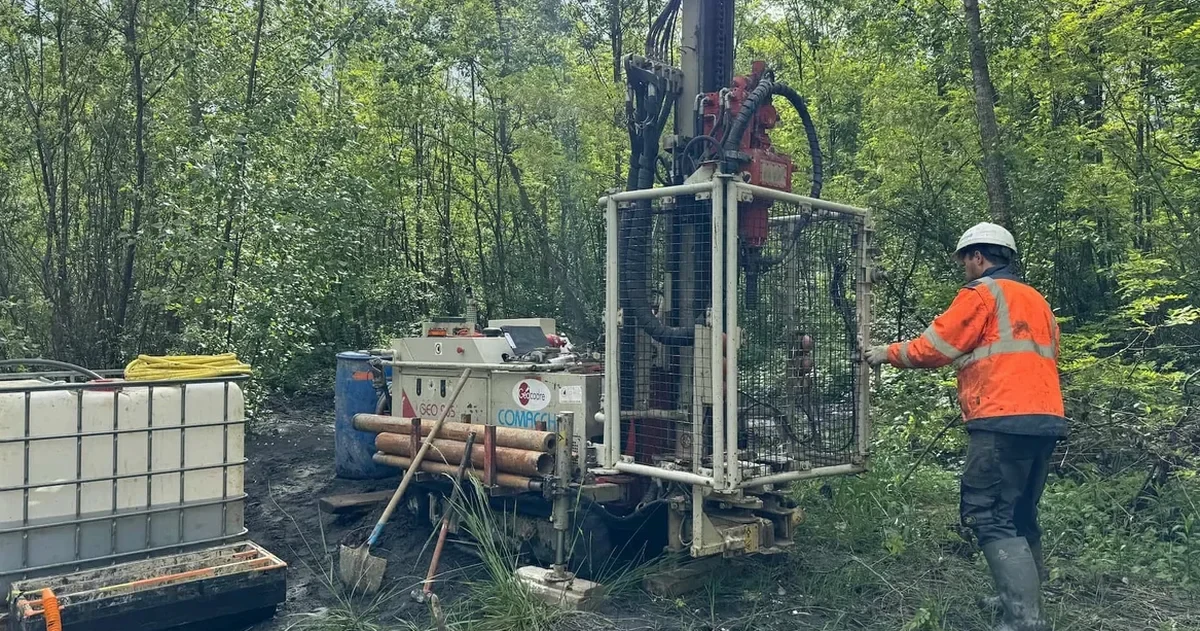
Oxnard sits on the deep alluvial soils of the Oxnard Plain, where the water table often rises within 10 feet of the surface during wet winters. The near-surface stratigraphy alternates between silty clays and loose sands deposited by the Santa Clara River, creating challenging conditions for shallow foundations. A proper soil mechanics study here has to account for capillary rise in the vadose zone, potential hydro-collapse in the silty layers, and the high compressibility of the organic clays found in the old marsh deposits east of the 101. We regularly sample these materials using hollow-stem augers to get undisturbed Shelby tubes, and when we need continuous stratigraphic resolution in the loose sands, we pair it with a CPT test to avoid the sample disturbance that can skew lab results.
On the Oxnard Plain, the difference between presumptive bearing and actual soil stiffness can exceed 40% across a single building pad.
Our approach and scope
The most common mistake we see on the Oxnard Plain is designing footings based on presumptive bearing values from the IBC table 1806.2 without verifying the actual soil stiffness of the basin fill. Those tables assume a generic non-cohesive material, but out here, the Pleistocene and Holocene interbeds can give you a bearing capacity of 2,500 psf in one corner of the lot and 1,800 psf in the other, just 30 feet away. Our soil mechanics study quantifies that spatial variability by running a suite of consolidation and direct shear tests on the undisturbed samples. We calculate immediate settlement under the design load and check the factor of safety against a bearing failure using the general shear equation from Terzaghi, modified for the local groundwater conditions that fluctuate with the irrigation cycles of the surrounding strawberry fields.
Local geotechnical context
The 2022 California Building Code (Title 24, Part 2) explicitly requires a soil mechanics study for any structure in Seismic Design Category D, which covers all of Oxnard due to the proximity of the San Andreas and Oak Ridge fault systems. The consequence of skipping this is not just excessive settlement—it's a differential movement failure where the loose, saturated sands in the upper 30 feet undergo cyclic mobility during a magnitude 6.5+ event. We have observed post-seismic tilting in light-framed commercial buildings near the Harbor Boulevard area, where the sand layers lost their effective stress and the footings punched through the desiccated crust. Our lab program includes cyclic triaxial testing on the critical sand units to determine the pore pressure generation curve, following the methodology from Seed & Idriss, and we back it up with SPT-based triggering correlations to give the structural engineer a site-specific peak ground acceleration threshold.
Standards that apply
ASCE 7-22 Minimum Design Loads and Associated Criteria for Buildings and Other Structures, ASTM D1586 Standard Test Method for Standard Penetration Test (SPT) and Split-Barrel Sampling of Soils, ASTM D2487 Standard Practice for Classification of Soils for Engineering Purposes (Unified Soil Classification System), IBC 2024 (California Building Code, Title 24) Section 1803 Geotechnical Investigations, ASTM D4767 Standard Test Method for Consolidated Undrained Triaxial Compression Test for Cohesive Soils
Common questions
What is the typical depth of exploration for a soil mechanics study in Oxnard?
For a standard commercial building with shallow foundations, we usually advance the borings to 40–50 feet below grade. This depth ensures we penetrate through the Holocene alluvium and into the stiffer Pleistocene deposits that serve as a reliable bearing stratum, and it satisfies the 30-foot liquefaction assessment depth required by ASCE 7.
How much does a soil mechanics study cost for a typical lot in Oxnard?
For a standard investigation with two borings, lab testing, and a signed geotechnical report, the cost ranges from US$3,390 to US$5,590. The final price depends on the depth of the borings, the number of consolidation and triaxial tests required, and the rig access conditions on site.
Does the study address corrosion potential for concrete foundations?
Yes. Given the agricultural history of the Oxnard Plain, the near-surface soils can have elevated sulfate and chloride concentrations. We run pH, resistivity, and water-soluble sulfate tests on representative samples and provide concrete mix design recommendations per ACI 318 to mitigate sulfate attack and rebar corrosion.
How do you handle the high groundwater in the Oxnard Plain during drilling?
We use hollow-stem augers as a temporary casing to keep the hole open above the water table, and we switch to mud rotary techniques if we encounter flowing sands below 30 feet. The groundwater level is measured 24 hours after drilling to get a stabilized reading, which is critical for the effective stress calculations in the bearing capacity and settlement analyses.