ASCE 7-22 and the California Building Code designate Oxnard as a location requiring rigorous seismic consideration due to its proximity to the Ventura-Pitas Point fault system and the broader San Andreas network. The city sits on a coastal plain underlain by Quaternary alluvium, where soft marine clays and loose sands amplify ground motion significantly. Base isolation seismic design addresses this directly by decoupling the superstructure from the ground, reducing spectral acceleration demands at the foundation level. Our laboratory team prepares site-specific design spectra from MASW surveys conducted across the Oxnard Plain, verifying that the isolator displacement capacity accounts for the near-field pulse effects often observed in Ventura County earthquakes. The IBC requires peer review for projects exceeding a risk category II threshold, and we coordinate that process with the local building official while ensuring the isolation system provides at least a 1.5 factor of safety against overturning in the maximum considered earthquake.
Base isolation in Oxnard requires displacement capacities exceeding 60 cm due to basin edge effects and near-field velocity pulses characteristic of the Ventura fault system.
Local geotechnical context
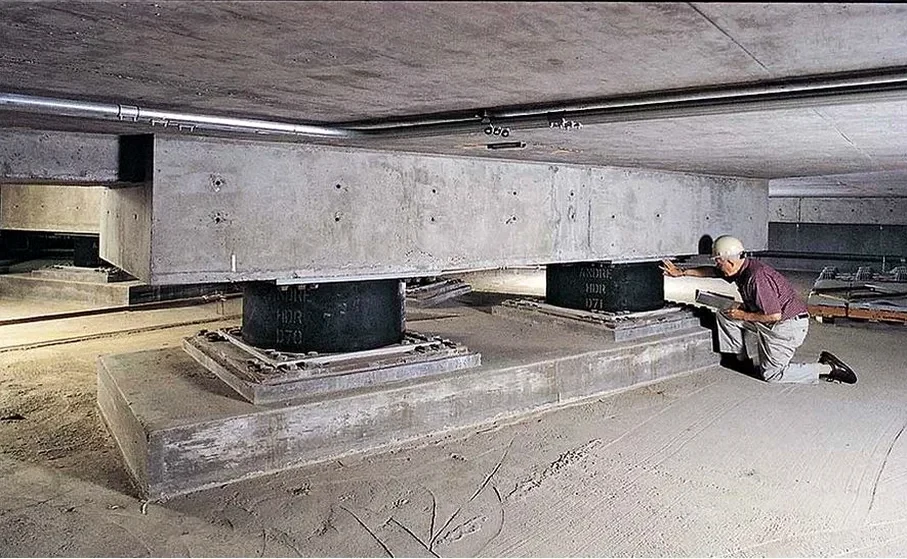
The physical installation of base isolators in an Oxnard project begins with the precise leveling of the pedestals atop the foundation, using a rotating laser level calibrated to ±1.5 mm across the entire footprint. Each isolator—typically a lead-rubber bearing weighing between 800 and 2,500 kg—is positioned with a mobile crane working within the confined moat excavation, where dewatering pumps run continuously to keep the water table below the bearing seat. The lead core yields at a predetermined force, and if the pedestal surface deviates more than the allowable tolerance, shim plates are installed under the bearing plate and grouted with high-strength, non-shrink epoxy. A single misalignment of 3 mm can shift the center of resistance enough to introduce torsional coupling that the isolation design did not account for. We verify each bearing's elevation and plan position against the structural engineer's shop drawings, and we document the as-built coordinates before the superstructure formwork proceeds above the isolation plane.
Common questions
What is the typical cost range for base isolation design on an Oxnard project?
For a building between 5,000 and 20,000 square feet, the base isolation seismic design package including site-specific hazard analysis, isolator specification, and peer review coordination typically ranges from US$4,020 to US$7,170. The final cost depends on the number of isolators, the complexity of the soil profile, and whether the project requires full nonlinear time-history analysis versus the simplified equivalent lateral force procedure.
How does the ASCE 7-22 base isolation chapter differ from previous editions for Oxnard sites?
ASCE 7-22 introduced updated risk-targeted maximum considered earthquake (MCER) maps that affect the Oxnard area, particularly for site class E conditions. The new standard also clarifies the requirements for bounding analysis of isolator properties, explicit modeling of the moat wall gap, and the use of peer review panels. For Oxnard projects, the most impactful change is the treatment of near-field pulse effects, which can increase the isolator displacement demand by 15 to 25 percent compared to the ASCE 7-16 provisions.
What geotechnical data is required before starting the isolator design?
We need a complete geotechnical report with shear wave velocity measurements to 30 meters depth, laboratory cyclic shear test results on undisturbed samples from the bearing stratum, groundwater monitoring data across at least one wet season, and a liquefaction assessment per the California Geological Survey guidelines. The report must also classify the site per ASCE 7 Chapter 20 and provide the low-strain shear modulus and damping curves for the foundation soils.
How long does the base isolation design and review process take in Oxnard?
The design phase typically requires six to eight weeks from receipt of the complete geotechnical data package. This includes the development of the design spectra, the preliminary isolator sizing, the nonlinear time-history analysis, and the preparation of the design criteria report. The peer review process, required by the IBC for risk category III and IV structures, adds an additional four to six weeks. The Oxnard Building Division generally processes base-isolated structure permits within the standard plan check timeline, but the peer review panel's comments must be resolved before the permit is issued.