← Home · Underground Excavations

Soft Ground Tunnel Analysis for Oxnard’s Coastal Plain Conditions

Together, we solve the challenges of tomorrow.

LEARN MORE →

Tunneling through Oxnard’s coastal plain geology demands a rigorous geotechnical framework grounded in ASCE 7 and IBC Chapter 18. The city sits on the Oxnard Plain, a deep basin filled with Quaternary alluvium, interbedded marine clays, and lenses of loose, saturated sand. Anyone who has worked a borehole near the Santa Clara River or the old wetlands east of 101 knows the profile: soft, highly compressible silty clays down to 60 feet, often with groundwater at 8 to 12 feet. A standard desk study will not cut it here. The real question for a soft ground tunnel is how the face will behave during sequential excavation and what the long-term consolidation settlement will do to surface infrastructure above it. Our geotechnical analysis for soft soil tunnels integrates in-situ permeability testing to quantify the drainage regime of the fine-grained Oxnard units before modeling the time-dependent deformation, because without accurate pore pressure data, even the best constitutive model produces misleading results.

In Oxnard’s marine clays, the difference between a stable face and a chimney failure is often 3 feet of cover and 200 psf of undrained shear strength.

Our approach and scope

Oxnard’s microclimate adds another variable that inexperienced consultants overlook. The persistent marine layer keeps near-surface soils at higher natural moisture content year-round, while the seasonal transition from winter rains to summer drought creates a shrink-swell cycle in the upper 15 feet of clay. For a shallow soft ground tunnel under a city street or rail corridor, that cyclic movement translates directly into additional lining loads. The ASTM D2487 classification of these soils typically reveals fat clays (CH) and elastic silts (MH) that fail the pocket penetrometer test before you even get the UU sample to the lab. We combine triaxial testing under consolidated-undrained conditions with pore pressure measurement to define the undrained shear strength profile that governs face stability. On the Oxnard Plain, you cannot rely on SPT N-values alone; the sensitivity of the marine clay requires a multi-stage triaxial program to capture the post-peak strength loss that controls the stand-up time at the tunnel heading.
Soft Ground Tunnel Analysis for Oxnard’s Coastal Plain Conditions
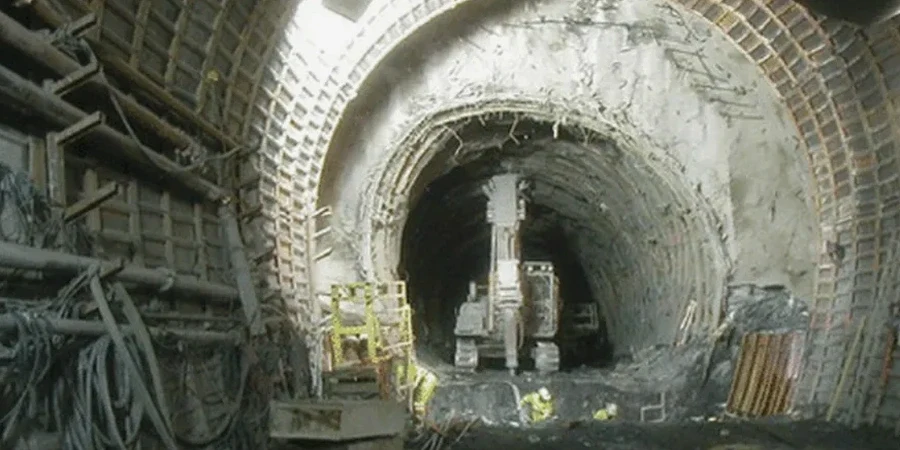
Technical reference image — Oxnard

Local geotechnical context

The soil profile changes noticeably as you move from the older alluvial terraces near downtown Oxnard toward the harbor and Channel Islands Boulevard. Near the historic core, you encounter slightly stiffer Pleistocene deposits that offer a few hours of stand-up time at the face. Head south toward the former marshlands around the power plant, and the Holocene bay mud is so soft that even a closed-face TBM struggles if the face pressure is off by half a bar. The biggest risk we see in geotechnical analysis for soft soil tunnels in this city is not the tunnel collapse itself, it is the surface settlement trough. With a row of single-story wood-frame structures on shallow footings along a proposed alignment, 2 inches of differential settlement cracks stucco and racks door frames. We run 2D and 3D finite element models calibrated to the CPT test data from the alignment borings to predict the settlement curve and design a compensation grouting program before the TBM ever arrives.

Need a geotechnical assessment?

Reply within 24h.

Email: info@geotechnicalengineering1.com

Typical values

ParameterTypical value
Undrained shear strength (Su) – Oxnard marine clay200 to 800 psf
Liquidity Index (IL) – soft clays0.8 to 1.4
Coefficient of consolidation (Cv)0.5 to 2.0 ft²/year
Groundwater depth (Oxnard Plain avg.)8 to 15 ft below grade
Plasticity Index (PI) – CH clays25 to 45%
Overconsolidation Ratio (OCR) – upper 20 ft1.0 to 1.5 (NC)
Standard Penetration Test N60 – soft zones2 to 6 blows/ft

Related services

01

Tunnel Face Stability Analysis

Limit-equilibrium and numerical modeling of face behavior in Oxnard’s soft clays, accounting for partial saturation in the upper tunnel horizon and the influence of nearby surcharge loads from rail or highway embankments.

02

Settlement Trough Prediction

2D and 3D finite element simulations using measured consolidation parameters to forecast surface settlement ahead of TBM arrival, allowing for pre-excavation grouting of vulnerable structures along the alignment.

03

Lining Load and Ground Reaction Curves

Development of the ground reaction curve for the Oxnard clay units to optimize the balance between shotcrete thickness, lattice girder spacing, and allowable convergence, reducing material waste while maintaining face safety.

04

Groundwater Control Design

Dewatering and pre-drainage system design based on in-situ permeability testing of the interbedded sand stringers common in the Oxnard Plain, preventing uncontrolled water inflow at the excavation face.

Applicable standards

ASCE 7-22 – Minimum Design Loads for Buildings and Other Structures, IBC 2024 – Chapter 18 Soils and Foundations, ASTM D1586 – Standard Test Method for Standard Penetration Test (SPT), ASTM D2487 – Standard Practice for Classification of Soils for Engineering Purposes, ASTM D4767 – Standard Test Method for Consolidated Undrained Triaxial Compression Test

Common questions

What is the approximate cost range for a soft ground tunnel geotechnical analysis in Oxnard?

For a typical soft ground tunnel project in Oxnard, the geotechnical analysis scope ranges from US$4,510 for a feasibility-level assessment with limited lab testing to around US$14,720 for a full design-phase package with triaxial testing, settlement modeling, and construction-phase instrumentation planning. The final figure depends on alignment length, number of borings, and the required detail of the numerical model.

How do Oxnard’s soil conditions compare to other tunneling projects in Southern California?

Oxnard sits on the deep alluvial Oxnard Plain, which means the soft clay sequence is thicker and more homogeneous than what you find in the LA Basin. Where downtown LA might hit the Fernando formation at 40 feet, Oxnard borings often stay in compressible Holocene clay to 80 feet or more. This requires a longer consolidation analysis and more conservative face support pressures.

Which laboratory tests are essential for characterizing Oxnard’s soft clays for tunneling?

We consider the consolidated-undrained triaxial test (ASTM D4767) with pore pressure measurement essential because it captures the undrained shear strength and stress path behavior of the sensitive marine clay. This must be paired with one-dimensional consolidation tests to define Cv and the compression index, plus Atterberg limits and grain size distribution per ASTM D2487 for a complete classification. Index testing alone is insufficient for tunnel design in these soils.
Location and service area

We serve projects in Oxnard and surrounding areas.

View larger map