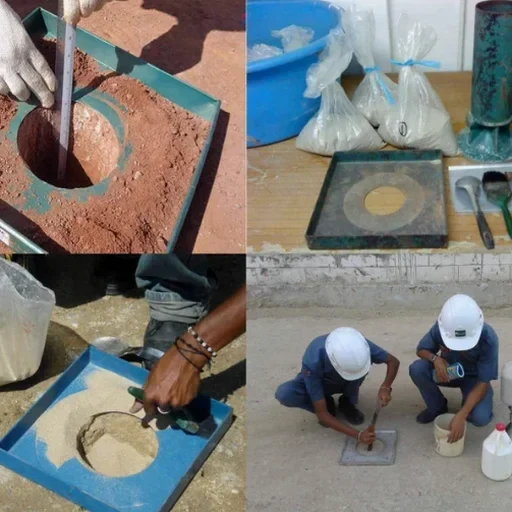
Oxnard sits barely 52 feet above sea level, with a population pushing 200,000 and a massive agricultural backbone that demands solid logistics infrastructure—warehouse slabs, distribution center pads, and access roads that won't settle. The Oxnard Plain is underlain by young Quaternary alluvium: interbedded sands, silts, and clays deposited by the Santa Clara River. These soils can look dense on the surface and fail a compaction test an hour later. We run the field density test using the sand cone method because it gives us a direct, physical measurement of in-place density. No nuclear gauges, no assumptions about moisture content from a probe—just a calibrated Ottawa sand and a base plate on the lift we're checking. For Oxnard projects near the river or on reworked agricultural land, it's often the difference between a slab that stays flat and one that cracks within two seasons. When we deal with deeper fill lifts or need a continuous profile to confirm what the sand cone shows at the surface, we'll often pair it with a CPT test to see how density changes with depth without waiting for lab results.
On Oxnard's silty alluvium, a passing sand cone test at 95% relative compaction is the only field proof that your lift will perform under load.
Local geotechnical context
The sand cone apparatus weighs maybe 12 pounds—a plastic jug of calibrated sand, a metal base plate, a density cone with a valve, and a field scale. Light enough to carry across a 40-acre Oxnard grading site in August, precise enough to catch a 3% drop in relative compaction that would fail a City of Oxnard building inspection. The real risk on the Oxnard Plain isn't the equipment; it's the soil variability. You can test five points on a building pad and get 96% compaction on four of them—and 87% on the fifth because that spot was backfilled over an old agricultural drain or a pocket of organic silt nobody mapped. That single low point, if missed, becomes a settlement hotspot under a rack system in a cold storage facility. We grid our tests tighter in Oxnard than the minimum spec requires, especially on projects within the groundwater influence zone where capillary rise keeps the lower lifts wetter than they should be during compaction. A dry density reading that looks borderline in the field can mean a failed re-test after rain, so we document everything and flag the marginal results the same day.
Common questions
What does a sand cone test actually measure in the field?
It measures the in-place dry density of compacted soil directly. We dig a small hole in the compacted lift, weigh all the excavated soil, then fill the hole with calibrated sand from a cone apparatus to determine the hole volume. From those two numbers—mass and volume—we calculate wet density, then apply the field moisture content to get dry density. That dry density is compared to the laboratory maximum dry density (Proctor) to give you relative compaction as a percentage. The entire process takes about 15 to 20 minutes per test point.
How much does a field density test cost in Oxnard?
A single sand cone test with moisture content and relative compaction calculation typically runs between US$110 and US$130 per point. For larger projects with multiple tests per day, the per-point rate drops. The final cost depends on how many tests we run in a shift, access conditions on site, and whether you need rush reporting. We'll give you a fixed rate before we mobilize—no surprises.
When is the sand cone method better than a nuclear gauge?
The sand cone wins on soils with high fines content—the silty sands we see all over east Oxnard—where the nuclear gauge can misread moisture and density due to chemical composition or organic content. It's also the go-to when you're testing around buried utilities or in areas where radiation sources require special permits. The tradeoff is speed: a nuclear gauge gives a reading in under five minutes, while a sand cone takes longer. But for critical acceptance testing where the result has to hold up to a city inspector's scrutiny, we prefer the sand cone every time.
How many test points do I need for a building pad in Oxnard?
The frequency depends on the project spec and the size of the pad, but as a rule of thumb we recommend at least one test per 2,500 square feet per lift for uniform soil conditions. On the Oxnard Plain, where you can hit a clay lens or an old agricultural drain line without warning, we often tighten that grid around the perimeter and under column lines. The City of Oxnard building department will review your testing plan during permit, and we help you write a frequency table that meets or exceeds the minimums so you don't get red-tagged mid-construction.