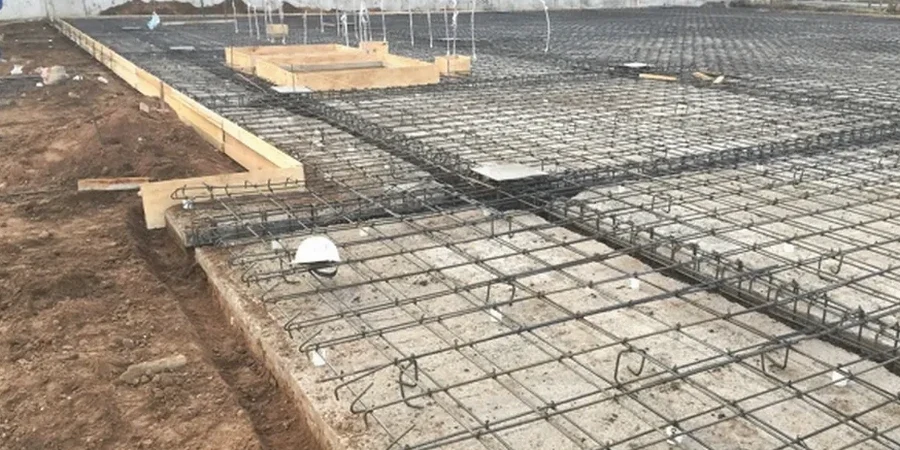
Oxnard’s coastal plain sits on deep Quaternary alluvium with groundwater often just 4 to 8 feet below grade. That changes the foundation conversation immediately. A spread footing might work on drier inland lots, but near the Channel Islands Harbor or across the Oxnard Plain, the combination of soft clays and a high water table pushes engineers toward a raft/mat foundation design. We see it repeatedly on mid-rise mixed-use projects downtown and on cold storage warehouses near the agricultural belt. The mat bridges localized weak zones and reduces differential settlement. The design accounts for the stiff, sometimes overconsolidated crust and the normally consolidated clays beneath—a profile typical of this stretch of the Oxnard Plain. For liquefaction-prone layers identified in borings, we often tie the mat into a ground improvement program using stone columns to densify the sand lenses before placing the slab. The intent is a foundation that works with the site, not against it.
A mat foundation in Oxnard is not a thick slab—it is a rigid structural element engineered to control settlement on compressible coastal soils under seismic load.
Our approach and scope
Raft/mat foundation design in Oxnard follows IBC Chapter 18 and ASCE 7-22 for seismic demands, given the city’s location within a high-hazard zone driven by the nearby San Andreas and Ventura-Pitas Point fault systems. The mat acts as a rigid diaphragm, distributing column loads across a broad footprint. We model soil-structure interaction using subgrade reaction moduli derived from in-situ plate load tests or CPT correlations—never just a textbook estimate. The design must accommodate both static and seismic load combinations, including the amplified short-period response typical of the soft clay sites mapped in the NEHRP soil classifications for Ventura County. Reinforcement detailing follows ACI 318, with careful attention to punching shear at column interfaces and temperature steel for slabs exceeding 3 feet in thickness. The structural analysis is iterative: we adjust the mat thickness until bearing pressures stay below the allowable values established in the geotechnical report. For Oxnard projects within the Coastal Zone, additional review triggers under the California Coastal Act influence grading and foundation elevation, particularly where FEMA flood zones overlap with the mat footprint. This regulatory layering makes local experience a practical necessity.
Common questions
What does a raft/mat foundation design cost in Oxnard?
The design phase for a raft/mat foundation in Oxnard typically ranges from US$1,180 to US$4,800, depending on the building footprint, number of column loads, and whether liquefaction analysis is required. Complex sites with deep soft clay and high groundwater will be at the upper end due to the additional soil-structure interaction modeling.
When is a mat foundation better than individual footings in Oxnard?
A mat is the right choice when the bearing capacity of the soil is low—common on Oxnard’s marine clay—or when differential settlement between columns must be minimized. It also works well where groundwater is shallow and individual footing excavations would require extensive dewatering. If the footing area exceeds about 50% of the building footprint, a mat is usually more economical.
Does the high groundwater in Oxnard affect mat foundation design?
Yes, significantly. The mat must be designed for hydrostatic uplift if the groundwater level is within 5 feet of the slab bottom. We specify waterproofing membranes, under-slab drainage layers, or permanent dewatering systems depending on the site. The buoyancy check is a mandatory part of the design per IBC 1805.1.