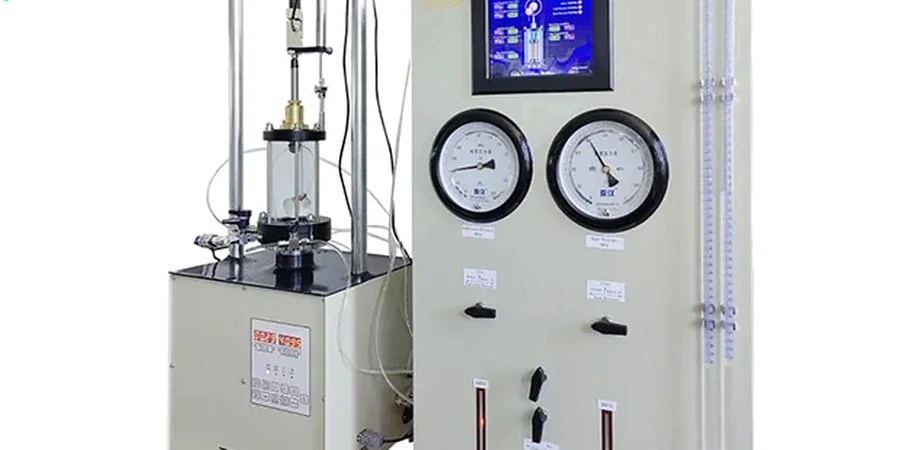
In Oxnard, the interplay between beach sands and the deeper, often saturated clays of the Oxnard Plain creates a subsurface profile that demands more than a simple soil classification. We see it constantly on projects near Channel Islands Harbor, where the water table sits just a few feet down. A standard penetration test gives you a number, but the triaxial test provides the complete failure envelope. Our team works with local contractors to obtain the effective stress parameters—cohesion and friction angle—needed for a defensible foundation design. Whether your site is within the liquefaction-susceptible zones mapped by the California Geological Survey or on the stiffer Pleistocene terraces toward Camarillo, the right triaxial test data prevents both over-excavation and structural under-design. For sites with very soft clays, we often recommend pairing our advanced shear testing with an in-situ CPT test to validate the laboratory-derived strength profile.
Shear strength isn't a single number—it's a function of drainage, confining stress, and loading rate, and the triaxial test captures all three.
Common questions
How much does a triaxial test cost for an Oxnard construction project?
For projects in the Oxnard area, a single triaxial test (UU, CU, or CD) typically ranges from US$1,690 to US$2,710, depending on the number of confining pressures required and the complexity of the sample preparation. A standard CU triaxial with three confining stages falls in the middle of that range. The final cost is influenced by the need for undisturbed sampling, handling of sensitive soils, and the reporting detail requested by the structural engineer.
What's the difference between a UU and CU triaxial test for Oxnard clays?
A UU (unconsolidated-undrained) test measures the undrained shear strength without allowing the sample to consolidate or drain. It's fast and applicable for short-term stability on low-permeability Oxnard clays where loading is rapid, like tank fills or earthquake scenarios. A CU (consolidated-undrained) test consolidates the sample to the in-situ stress first, then shears it undrained while measuring pore pressure. This yields effective stress parameters (c' and φ') that can be used for both short-term and long-term analyses. Most structural engineers in Ventura County request the CU test because it provides the full failure envelope.
How long does a triaxial test take from sample collection to report?
A standard CU triaxial test on a cohesive soil typically requires 7 to 10 calendar days from the time the sample arrives at our laboratory. The consolidation phase alone can take 24 to 48 hours for low-permeability Oxnard clays, and the shearing stage must be run at a slow, controlled strain rate to ensure pore pressure equalization. Expedited turnaround is available if the project schedule demands it, but we always advise against rushing the saturation phase—an incomplete saturation leads to incorrect effective stress parameters.
Do I need a triaxial test if I already have SPT blow counts from my Oxnard site?
SPT blow counts provide an index of relative density or consistency, but they do not directly measure shear strength parameters. For any project involving a retaining wall, slope, or a foundation in Oxnard's soft clays, the structural engineer needs the friction angle and cohesion to perform a bearing capacity or stability analysis. We have correlated SPT N-values with triaxial test results for many Oxnard Plain soils, and the scatter is significant—a blow count of 8 can correspond to an undrained shear strength anywhere from 500 to 1,200 psf. The triaxial test eliminates that uncertainty.