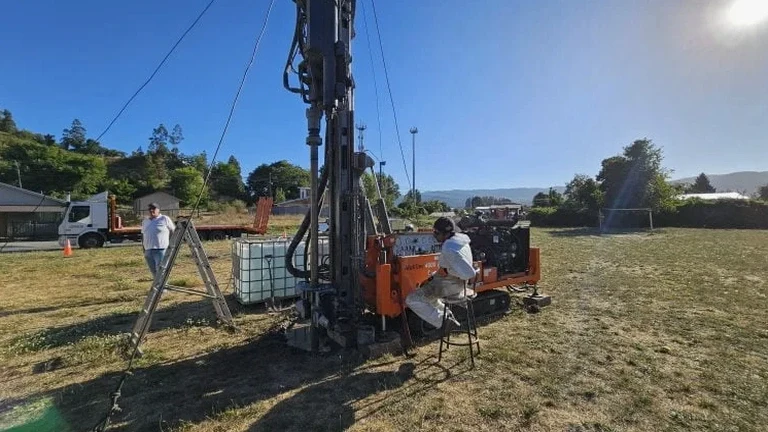
A contractor near Oxnard Boulevard hit buried organic clay at two feet, right after stripping the old asphalt. The original geotech report missed it. That is the value of an exploratory test pit—you see what the drill rig cannot capture in a thin-walled tube. Oxnard sits on the Oxnard Plain, with Pleistocene and Holocene alluvium overlying deeper marine deposits. Stratification can flip in less than 50 horizontal feet. We open pits to 12 feet, log the face, and pull undisturbed samples. When the soil smells of agricultural sulfur from decades of row crops, we flag it immediately. For deeper refusal data, we pair this with SPT drilling to correlate blow counts with what we see on the pit wall.
A pit wall reveals stratigraphy that a 3-inch boring never will—especially in Oxnard, where old slough channels hide under farmland fill.
Local geotechnical context
Chapter 18 of the IBC, adopted by the City of Oxnard, requires soil classification for bearing capacity determination. A missed compressible layer under a footing is a code violation and an expensive repair. On the Oxnard Plain, groundwater is often high—within five feet of the surface in winter near the coastal zone. A test pit lets us watch seepage enter in real time, measuring the rate and source, something a boring log can only estimate. If we encounter undocumented fill with debris, the structural load path changes. The city’s Building and Safety division will red-tag a project that proceeds without adequate subsurface exploration. The pit provides photographic evidence that holds up during plan check. It is cheap insurance against a foundation failure.
Common questions
How long does it take to open and backfill a test pit in Oxnard?
Most residential and light commercial pits are opened, logged, sampled, and backfilled within one day. We use a rubber-tire backhoe for access on finished lots. If the city requires compaction testing on the backfill, we add a half day for density verification.
What is the cost range for an exploratory test pit?
For a standard pit to 10 feet with a written log and photo record, budget between US$470 and US$900. The final number depends on access, depth, and whether lab testing is added. Pits that hit obstructions or require shoring go to the upper end.
Do you need a permit to dig a test pit in Oxnard?
Not typically for exploratory work on private property, but we always call USA North 811 for utility clearance before digging. If the pit stays open overnight, the city may require fencing and a grading permit—something we handle in the planning phase.
Can a test pit replace a boring for foundation design?
It complements it. A pit gives you continuous visual data and bulk samples but is depth-limited. For footings at 3 to 5 feet, it is often sufficient. For deeper loads or pile design, we recommend pairing it with a boring or CPT sounding to capture the deeper stratigraphy.